Showing posts with label be safe. Show all posts

Thursday, June 13, 2013

favorite thing friday: the quest for world peace (alternatively titled, the war against road rage)

This morning, I had to be in the office at 8:00 for a meeting.  Because I didn't return home last night until midnight (after having been on a business trip to Houston), I was feeling a little less than stellar when I woke up today.  But after I smothered the kids in hugs and kisses, I darted off to work.   On my less than nine-mile drive in to the office, I heard honking - no less than five times. Not just a "toot-toot" but a HOOOOOOOOOONK! If those horns could speak, they would be saying, "Get off the road, you bumbling fool!"  

At one juncture, the man in the car next to me was laying on his horn and honking so aggressively at the person in front of him, who had merely slowed down because she realized that she was in the wrong on-ramp to the freeway and needed to merge, my blood pressure instantly went through the roof and I started to honk at him, for honking at her, before I stopped myself and instead started yelling the Lord's Prayer.

Forgive us our trespasses as we forgive those who trespass against us! And lead us not in to temptation! Please, please, please deliver us from the evil that would occur if I forced this dope off the road and into a ditch!!

Oh, I know better than to let other's reactions behind the wheel upset me. I've taken defensive driving for the past several years through the Smith-System Program, which I can not recommend highly enough.  And while I know that the horn has a purpose on the car, I very, very rarely use it because I think it is rude and obnoxious and stress-inducing. Why, I dislike horns so much and was so inflamed by all of the people that used them when we first moved to this area, this is my license plate:

photo-8

If I'm sitting behind someone at a light and the light turns green, I'll give the person a few solid seconds before I tap my horn. And if someone is merging in to my lane, of course I'll slow down and let them in. Why would I speed up and honk my horn? What if the person inside is sick or sad or dealing with a terrible loss? What if they are a brand new driver and nervous, or what if they are elderly and tentative?  Or, what if they are transporting a brand new baby?  Or, what if they don't feel comfortable making a turn on green because the cars are coming a bit too fast from their perspective?

What do you think of that, over-zealous horn honker?

Two months ago in Virginia, just down the street from our house, there was a situation where a 57-year old man was driving a car and a 63-year old man behind him, was (purportedly) honking his horn.  He honked at him once when the 57-year-old didn't accelerate fast enough once a light turned green, and then he did it again at the next light.  As fate would have it, the 57-year-old man, who was a Religious Education teacher at a local Catholic school, really didn't appreciate being honked at and perhaps didn't think to recite the Lord's Prayer.

Instead, he allowed the 63-year old to go in front of him, and then he followed him in to a parking lot, climbed out of the car, approached the man and said, "One day, you're going to get your ass kicked...." before he PUNCHED him in the head.  Long story short, the 63-year old died a few days later from a brain bleed resulting from the punch to his head. Resulting from him rudely honking his horn at a stranger who wasn't going fast enough through green lights. Resulting from a general acceptance of behaving uncivilized on the roadways.  Resulting from a civilization that unquestionably needs more fiber and general kindness in its diet.

Here's what I think:  I think that driving is the most dangerous thing I do all day. And I think there's a rage in a lot of people that lays just below the surface, manifesting itself once people get behind the wheel.  This rage especially brews when people are busy and stressed. I think that in more crowded areas, people can completely lose track of their humanity. And I think that this rage, this scary rage, can make us do things that we might never even believe that we would be capable of doing. I know that my neighbors whose daughter goes to the Catholic school, certainly never thought that their education director would be facing homicide charges because of road rage.

It comes as no surprise to me that the drivers of Washington, DC (and the surrounding area), are among the worst drivers in the United States of America.  While I try to allow three to four seconds of lead time between myself and the car in front of me,  I'm always stunned at how fast and close people around here drive and how not a day passes that when I'm out driving, I'll witness some kind of altercation on the road.  As a result of those factors, drivers in this area are 107.3 times more likely to have an accident than the national average.  People are generally overworked and overwhelmed and so they take out their frustrations during their long and busy commutes.

Because I'm striving for a better world for my children, in addition to honing my defensive driving skills and demonstrating graciousness to fellow drivers, I'm adding a few of these Shticks to my car...

51OC532LAwL

Already, I expect they will be a favorite thing. I figure, if they add any levity to the insanity that is driving in this region, I think their purchase will be money well spent.  I'm just hoping I don't inadvertently hold up the "Jackass" of "WTF!" sign when I meant to hold up the "Thanks!" or "Have A Great Day!"

I anticipate that snafu might cause some trouble.

Tuesday, June 30, 2009

safe driving 101, part 1

I recently completed my annual driver safety refresher training.

Seeing as traffic will be at an all-year high this holiday weekend, as people around the United States take to traveling far and wide in celebration of Independence Day, I thought this would be a perfect time to share the knowledge that I learned ... with all of you ... in an effort to keep you safe.

Because I care about you that way.


And since you may be on the same road with me or my precious family, I believe it is important to impart whatever knowledge I have about driving safely to those who read this little blog.

This Driver Safety post has taken me several days to write. I will be publishing it in segments throughout the day, as opposed to one huge post at once, because I fear anyone who tries to read it all at once would lose consciousness. But I will be taking roll and I fully expect you to read it in all of it's entirety.

There will be a quiz at the end.


Now before I dive in to this critically important post - I think it's important to note that I work for a company that takes safe operations very seriously.

In all of the training seminars that we take in order to insure that our activities are executed flawlessly, it is stressed that our behavior dictates our safety. As such, we subscribe to a philosophy that in industry, is commonly referred to as "Behavior-Based Loss Prevention."

The driving safety program that our company subscribes to is from the Smith-System Driver Improvement Institute, and it falls under this Behavior-Based Loss Prevention category. Almost everything included in this post series, has been taken directly from the Smith-System Driver program.

The five keys that I'll be referencing in these posts are registered by Smith-System and are noted, accordingly. Although I've done my absolute best to include an overview of the program here, if you ever have the opportunity to attend a Smith-System Driver Safety program, I would highly (highly, highly) recommend it. There is absolutely NO comparison to reading about how to drive safely and taking a real class, where you are required to get behind the wheel while a Smith-System Trained Instructor analyzes your driving.

Just ask Charlie.

I'm not even a Trained Instructor but since I've had the training at least five times, I critique him constantly when we're on the road. It's awesome and a great marriage builder. (Or not.)

OK. Pour yourself a cup of tea and let's get started.

Every year, thousands and thousands of people die in pointless traffic accidents.

Why?

There are many answers to this question. But the most important answer is that precautions were rarely taken to prevent these tragic accidents. True, some accidents are inescapable. But of the MILLIONS of accidents happening every year, only a small percentage are truly non-preventable.

Yet, the right precautions do prevent accidents. And seeing as we spend a large portion of our lives driving, we need to be cognizant of what those precautions are. Especially considering many of us are transporting life's most precious cargo.

These pictures below were sent to me, today, by a colleague at work.

Do you see the motorcycle?

How about now?

The driver and the passenger in the car were talking on a cell phone. The driver of the car didn't see the motorcycle and the motorcyclist, who was driving at 85 miles per hour, didn't notice the bright red car - edging out at the intersection. When the paramedics arrived, they extracted three victims from the red car. The motorcycle driver - the driver - and the passenger.

They were all killed instantly.

The Smith-System is a series of interlocking techniques for preventing accidents. They help drivers to see, think and act their way through the multitude of driving environments, challenges and changes that exist no matter where they travel or what types of vehicles they operate.

Total awareness, perceptive anticipation, accurate forecasting, early detection and deliberate reaction are the primary features of these techniques.

Behind the variety of unique reasons for every accident are common contributing factors that repeatedly come in to play. But most of these factors include human error. They include:

Inattention: It might surprise you that most of the drivers on the road don't pay enough attention to the serious business of driving. Yet change is the most constant thing on the road. There are an endless variety of things that must be identified and analyzed, at every moment.

Too Much Attention to Too Little:
Some drivers concentrate too much attention for too long one item, while missing others of equal or greater importance.

Not Enough Time: Drivers often do not allow themselves adequate time to make important decisions and act upon them. This is usually caused by not seeing enough, soon enough.

Not Enough Space: Drivers frequently accompany each other in close-knit packs, leaving themselves no maneuvering room if they need to steer clear of a sudden problem. They tailgate both inside and outside of packs.

Not Allowing for the Mistakes of Others: Drivers often fail to see or anticipate the mistakes of others in time to avoid conflict.

Not Enough Training:
Fundamental training is often very inadequate. Many drivers are turned loose in the traffic world after gaining only limited knowledge of local laws and the basics of vehicle handling.

Failure to Adjust to Conditions:
Changing road and weather conditions require drivers to adapt and to modify driving techniques. Many drivers don't adapt to circumstances, or are slow to recognize their importance.

Driver Impairment: The influences of alcohol, drugs, fatigue and illness can lead to accidents.

Vehicle Failure: This causes a very small percentage of accidents. Many of them can be avoided if drivers take the proper precautions.

Up next ... the first of Five Keys to Driving Safely.

Go grab yourself a donut.

Thursday, May 21, 2009

i don't mean to scare you. but ...

Last year, one of my girl friends told me a story that has since haunted me.

When she was a teenager, several of her family members had come over for an afternoon pool party. As the day wore on, people began to migrate from the pool in to the house. After a certain point of time, her sister-in-law became concerned that she hadn't seen her three-year-old son. People started looking for him although everyone had assumed someone else had him.

Because surely someone was watching the baby. Right?

My girlfriend went out to the pool area and after a quick scan of the pool, didn't see him. But she did notice that several of the inflatable pool toys had congregated in the far corner of the deep end. When she went over to the deep end and started pulling the various toys out of the pool, she found her three-year-old nephew floating under a raft.

Sadly, he was long gone.

Not many years later, my girlfriend's family hosted an exchange student from Israel. He was married and actually had a wife and two small children that remained at home while he came to the United States to finish up his college degree. He didn't know how to swim and although my friend's brothers often told him that they would be more than happy to teach him in the family pool, he never took them up on their offer.

Probably because he was embarrassed.

One afternoon, when the family returned home from a day out, they noticed that the back door leading to the pool area was open. Just as they stepped outside to close the door, they caught the sight of someone on the bottom of the pool. It was the exchange student, who had tried to teach himself to swim when he didn't have anyone watching.

Sadly, he wasn't successful.

Within a matter of days the family had the pool filled in with concrete and a few months later, they moved.

When I was a child, a three-year-old little girl that lived down the street fell in to her family pool. It was January and she fell right through the cover in to the stagnant water below. She might have drowned if not for her brother that told her mother that she had fallen in to the pool and the level-headed mother who ran outside, jumped in to the pool, tore through the cover and pulled her blue toddler out. She administered Cardiopulmonary Resuscitation (CPR) and her baby survived.

When I was a teenager and on the swim team, I remember showing up for practice one day and spotting an unusually large object on the bottom of the pool. There was a moment of stunned disbelief when I thought, "Is that what I think it is?" before I started to yell for help. Sure enough, a young girl who had been part of an afternoon swim class and had been playing on the pool ropes slipped over in to the deep end. Almost everyone who had been standing pool side jumped in at the same time to rescue her. She was administered CPR and taken by ambulance to a local hospital. From what I recall, she was in a coma for two weeks before regaining consciousness. But sadly, she sustained brain damage from oxygen depletion.

Last summer over Labor Day weekend, when I was sitting at the neighborhood pool with my mother, we noticed that there was a helicopter circling a few miles away. On the news later that night, we heard that a young child who had been playing in the pool - surrounded by her family - had ventured in to water that was too deep. After several minutes, it was discovered that she had sunk to the bottom. They helicoptered her to Children's Hospital but it was too late. Even though her family had been there, actually in the water with her. Even though there was a lifeguard on duty. In the blink of an eye, she was gone.

Having worked as a lifeguard and taught swimming lessons, I have a moral obligation of stressing the importance of knowing how to swim. And as the daughter in-law of Kathleen, "Gator-Head Grannie", I feel compelled to use my blog as a platform to propagate drowning prevention.

Kathleen is amazing and in addition to winning countless GOLD medals (not silver or bronze) for swimming in the Senior Olympics, she has swum from Alcatraz Island to Fisherman's Wharf. Now she is swimming 100 miles, with a bottle on her head, to raise awareness for drowning prevention.

Last week, she swam in the Bahamas and taught local children how to swim.

Earlier this year, she swam in 41 degree Alaskan glacier water, sans wetsuit.

If you do not know how to swim, please do not be embarrassed.

Instead, make it your mission to learn.

You never know when you might need to save someone's life - or your own. There are classes offered through a variety of different organizations. Swimming lessons are typically available in most communities through private gymnasiums and programs such as the American Red Cross, Swim America, public schools, YMCAs, and sports clubs.

This is a fantastic link (HERE) that I suggest everyone click through to read about water safety and some of the myths about drowning. Here are some of the facts taken directly from the article:
  • Most drownings occur in less than four feet of water.
  • When you assume everyone is watching, usually no one is. Unless someone is diligently watching the water (including the pool bottom), the individual may go unnoticed until it is too late for resuscitation (CPR) to be effective.
  • Flotation devices (floats, noodles, rafts, etc.) usually require an individual to hold on, sit on, or lay on the device and are not dependable. Among other risks, flotation devices increase the chance of weak swimmers falling off in water that is deeper than they would swim in without the float.
  • Drowning victims typically do not thrash, splash, or yell for help. Many drownings are "silent"; a person has submerged and is unable to return to the surface therefore, the struggle occurs underwater and the victim makes no sound.
  • Accidents are never expected events, and therefore can happen to anyone at any time. Being prepared to react and give care during an emergency can often be the difference between life and death -- for yourself as well as the person in trouble.
Everyone needs to learn to respect water - and a certain degree of fear is not a bad thing. And if you think that you or your child are competent swimmers, the next time you go to the pool, jump in with all of your clothes on. There is a very good chance that if you ever have a close encounter with drowning, it might be when you fall in to a body of water, fully clothed.

Socks. Shoes. Shirt. Pants. Hat.

(Possibly holding a fishing rod.)

Many years ago, I was very involved in synchronized swimming. During one of the regional shows that our team put on, I was required to do a cartwheel in to the pool wearing a long flowing nightgown over my team bathing suit. The plan was that once I was in the water, I would simply pull the nightgown off, leaving behind my suit.

Since I had been sick with the flu the entire week leading up to the performance, I had never had the opportunity to have a dress rehearsal. So the first time I attempted this move was when I was under the spotlight in front of 200 people. Suffice to say, the experience of swimming when you are fully clothed is entirely different than when you are in a bathing suit. And when I went underwater and was wrapped in a soaking wet nightgown that stuck to my head and arms and I couldn't tell which way was up, it took everything in my power to not flail to the surface screaming for help.

Even if you are hanging out at the pool, life jackets on children who do not know how to swim are a GOOD idea. Of course if your child is 22-months old and goes by the name of Henry, it would probably be easier to saddle a bucking Bronco than put them in a life jacket. But safety is one of those few things that cannot be negotiated. Also, just because your child has a life jacket on, does not preclude you from watching them at all times.

Seeing as this is Memorial Day weekend, are you familiar with the the ABC's for Drowning Prevention?

A: ALWAYS watch your kids around water. Although I have my hands full when I take all four children to the pool by myself, I feel the safest when I am on my own because I know that I am fully responsible for their safety. They know that they have to play in one area because I can't be diverting my eyes from one spot of the pool to another. And if they don't abide by my rules, we go home. If you are at a body of water with multiple people, task at least ONE PERSON with being a spotter. It is their job to keep their eyes on the water to make sure people in and around the water are safe. Don't make the mistake of assuming that this is being done.

B: BARRIERS must be installed to keep children away from water if you are near a pool or a other water body. Don't assume that just because you tell a child to stay away from water, they will listen to you. If you live in an area where there is a nearby water body and you have small children, keep your doors and windows locked. I have heard too many stories of children who walked out an open door - or climbed through a fence - and drowned in either their own pool or a neighbor's.

C: CLASSES and CPR. If you or your child doesn't know how to swim, LEARN. If your child is too young (personally, I don't think that children are truly capable of understanding and/or having the physical strength to swim until they are 3.5 to 4 years old), the development of safety awareness, water skills, and a sense of enjoyment of the water should begin at home in the bathtub.

If someone collapsed in front of you - or you pulled someone who was unconscious from a body of water - would you know how to administer CPR?

Two rescue breaths, followed by 30 chest compressions?

No?

Then what are you looking at?

Leave a comment on THIS post and tell me what you are planning to do for Memorial Day Weekend. I am going to take the total number of comments and randomly select someone to win a CPR Anytime Kit. This compact kit allows you to learn and teach, the simple and yet critical technique that could save the life of a loved one. You have your choice of a dark skinned or light skinned mannequin, although I'm fairly certain, color doesn't matter.

I'll select a winner on Monday night. Until then, just think how great it would be if you won. You could host parties where people from your neighborhood come over and in 22 minutes, learn how to resuscitate someone. And then, you could have a potluck.

I seriously think you'd be the coolest house on the block.

Now, if you're concerned about the spread of infectious diseases during the course of administering CPR, you can always pick up a few of these CPR Medic pouches. We actually have one in each one of our vehicles, and I carry one in my diaper bag, purse and briefcase. I like to always be prepared.

And ... well ... it seems I have a problem leaving the house with less than 50 pounds of stuff.

Wednesday, April 08, 2009

ditch the corded blinds

It happens every so often, that I will stumble upon a blog and it feels like someone has pulled my heart straight out of my chest.

This beautiful little girl is Gretta Claire Wyman.

Gretta died last September, at the age of two, when she was caught in the cord of a window blind. One minute she is excitedly playing on the couch waiting to go see horses for the first time. The next minute ... she's gone.

There are absolutely no words to describe the horror surrounding this kind of accident. There are absolutely no words to describe the grief that this family is feeling. This is a link to Gretta's mother's blog. If you feel so inclined, please drop by and offer her your condolences and words of support. What she is going through right now is unfathomable.

And then, please go check out this link regarding window blind safety.

A child dies every two weeks from strangulation on corded window treatments and children as old as 12 have been strangled. Much like we bolted all of our heavy furniture to the walls after reading this story, we've recently pulled down the blinds in our children's bedrooms and have opted to have curtains up, instead.

My heart absolutely breaks for any family that suffers the loss of a child. But I firmly believe that whenever something tragic occurs, it is so important to spread the word on the accident in an effort to inform and hopefully, protect others.

One child dies every two weeks from corded blind accidents.

That's one child too many.

Thursday, August 07, 2008

keeping them safe

A few weeks ago, Charlie rode his bicycle to a local hardware store to pick up a few supplies to repair the drain on our bathtub. I hesitated when he told me that he was riding his bike on this particular errand, because I knew that he would have to cross over a relatively busy intersection and the roads in our area are especially congested since the traffic in our neighborhood has increased 100-fold in the past 10 years.

When he told me his plans that involved a four-mile round-trip bike ride, my entire life with this man flashed before my eyes. I could imagine him getting mowed over like a blade of grass by some punk kid that just got their learner's permit, and there was my beloved husband and father of four children, laying on the side of the road, bleeding, fading from this life and in to the next.

I didn't tell Charlie any of this.

I didn't tell him that I was afraid he was going to be hit and killed by a car when he was attempting to make a left. Because if I had, my husband might think that I was a bit UPTIGHT and PARANOID.

Instead, when I looked out the kitchen window and saw that he was pedaling his bike down the street without a helmet, I threw down the baby I had been nursing, grabbed the helmet that was sitting on the kitchen table, and chased my husband down yelling "HONEY! HONEY! You forgot THIS!!!" and then I added, "Whatever you do, don't go to the light. I need you here, on earth." He laughed before giving me a kiss and saying "I'll be FINE!"

I stood there watching him ride off, until he disappeared from view.

Of course he'll be fine.


That's what our loved ones always say before they join the ranks of angels.

Twenty minutes later, when my mother called, I told her that I was worried about Charlie. I told her that he was out riding his bike on the BUSY roads in our neighborhood and I was worried something was going to happen to him. She said that it was normal to have fear. But when I added that I was waiting for the police to come knock on my door and say that he was hit and I'd need to figure out how to raise four children all by myself, she told me I was a loon.

When Charlie walked in the door a few minutes later and overheard me talking to my mother about his funeral arrangements, he was flabbergasted. "But, I just went for a bike ride and you are burying me already?!"

"No," I replied. "I'm not burying you, I'm planning to have you cremated. But yes, I'm talking about your arrangements and until you run errands in a TANK this is the price you have to pay for being married to me."

Fear. I've got it. I've got lots of it.

I tell myself that it's normal to have a healthy dose of fear because fear is an instinct that can help to keep us safe. It is because of the fear that I have that something will happen to me or my family, I try to be as prepared as possible. But I know that in order to keep my children safe, there is more that I need to do than arm myself with a first aid kit, pepper spray and a reflective security blanket.

The world can be a very scary place.

Two months ago, after having seen a review on Protecting the Gift, I purchased the book and within 24-hours of it arriving on my doorstep, had read it from cover-to-cover.

It was an eye-opener for me to read that 1 in 6 children have some form of sexual involvement before the age of 12 and it was extremely frightening to read that nearly one million school kids, grades 6 to 12, carried a gun to school last year.

One million.

Parents must be more diligent in knowing what is happening in their children's lives. Who are their friends? Who are their teachers? Who are the people that they interface with? What are they doing?

The primary message that I picked up from this book is that in order to protect the gift that is our children, we must be educated on how to protect the gift of intuition and fear. Currently, I'm trying to teach our children how they shouldn't walk up and talk to everyone that they meet. I've told them that like the diver in Finding Nemo, if they don't listen and come to me when I call them, they can be picked up and taken away.

I've told them that they must protect themselves and look out for each other, and if anyone ever treats them poorly or touches them inappropriately - they need to let me or their father know. I'm trying to explain to them in terms that they can understand how not all people in the world are good. This is proving to be a lot more difficult than I expected because children are naturally curious and very trusting and the last thing I want to do is traumatize them with the message I'm attempting to convey.

But my job is to protect my children and I'd prefer that they be a little afraid than have no fear.

I've written before that I really enjoy sharing stories of my family with people that know us and even with those who don't, through this blog. According to my statistics meter, I receive a few thousands visits, every day. On the one hand, I am really flattered to know that so many people visit this website and enjoy reading about our lives. But when I noticed that the most frequent pictures that are viewed from various search engines were pictures of my babies' bare bottoms or photos of them sitting on the potty, I immediately went to those various pages and deleted the images.

When I started receiving e-mails earlier this week from my YouTube account indicating that I had messages on the potty training video I uploaded in January, I was blown away to see that a video I uploaded eight months ago had received over 20,000 visits in two days. After a little research, I found that my slide show had been picked up by two "Classic Rock" radio stations and was featured on the front page of their websites.

Then, yesterday, I received an e-mail from someone that indicated a "woman" from a parenting board that they frequent had stolen pictures of my babies and my triplet birth story from this blog, and after some very slight modifications, posted it as her own. Interestingly, it didn't bother me as much that this person had hijacked my picture and story as much as it troubled me that she might try to prey on people's sympathies for money or who knows what. One hundred years from now, it isn't going to matter if someone took my story and photos, unless they tried to cash them in on a book deal.

The fact is, both of these incidents have brought a lot of attention to my blog - a lot of attention that hasn't been particularly nice or good and I'm not sure what I'm going to do about it. One option that Charlie and I are seriously considering is to make the blog private. My fear is that there are a lot of people out "there" with ulterior motives and I don't want them seeping in to my children's lives via the internet. Suffice to say, there is some serious soul-searching going on right now about what this blog is, why it's here, and what it's future should be.

If only I could stick a helmet on it and arm it with pepper spray, I'd feel a whole lot better.

Tuesday, May 20, 2008

i was the one furiously taking notes

Before I keep diving in to organizational tips, which believe you me - I will continue to do - I want to quickly jot down some thoughts on a meeting I attended today. Actually, it wasn't a meeting so much as it was a training session. Regardless, I learned a lot that I thought was important enough to pass on.

The session I attended was an 8-hour "refresher" course for HAZWOPER (Hazardous Waste Operations and Emergency Response) which is required for my job. Ever since having first obtained my 40-hour HAZWOPER certification in 1996, I have attended this 8-hour refresher course which is required to keep my certification - every year - for the past 12 years.

Sometimes, the course is so boring I will run a brand new pen completely out of ink drawing figure eights in my handouts. Other times, like today, the class is so fascinating - I am perched on the edge of my chair waiting to hear what the instructor will tell us next.

For the most part, we watched movies of catastrophic work place events that were completely preventable, in rapid succession. This was really troublesome because NONE of these events should have happened and as a mother, I kept thinking, "What if that was my child, inside?"

We saw footage of the Texas City fire at the BP Refinery in March of 2005 which claimed the lives of 15 people. We then watched a re-creation of the rocket fuel explosion at the Pepcon facility in Henderson Nevada in May of 1988. Here's the video. Sadly, the man that made the call to 911 was wheel chair bound from polio and perished in the explosion. We watched a video on a propane tank facility explosion in Korea. And then we watched a video on the fire at the EQ facility in Apex, North Carolina in October of 2006, that required the evacuation of 16,000 townspeople.

At one point, my co-worker leaned over to me and whispered "Holy Crap. This is like disaster porn."

We learned that up until recently (and perhaps even still?) many hard candies have high levels of lead because the molds used to make the candy are made with lead, and when the hot liquid is poured in, the lead leaches out. And the acidic content of the candy can cause further leaching.

We learned that much of the jewelry from the Oriental Trading Company and Limited Too, were made with between 87% and 100% lead. So, if a child ingests a clasp on the necklace - it could be fatal. Sure, much of this stuff was recalled last year. But I didn't get that memo.

Did you??


The maximum lead allowance is 0.06%, or 600 parts per million. However, the levels that were showing up in various toys were 11% or 110,000 parts per million. Almost twice what has been allowed by law for the past 30 years. This is why I believe in playing with natural wood toys and giving our kids pots and pans and a spoon to bang them with. This is also why I've spent the past 30 minutes evaluating all the toys on the Parents Recall website (for the past few years), to insure none of those items are in our home.

We learned about safe tips for fueling your vehicle. Things like ... explosions from static electricity igniting gasoline are a lot more common than one might think and 78% of those explosions involve women who are either getting in to their car while they are pumping gas to check on their children, grab their purse - or get out of the weather. We learned that to safely fuel your vehicle you should:

1) Always shut off the vehicle.

2) Once you've started pumping fuel, do NOT re-enter the car. Remaining outside of your vehicle will help to insure that you do not overflow your tank, and also - will decrease the chance of static electricity building up.

3) If you do need to re-enter your vehicle, touch either the metal door of your car - or the dispenser - to discharge the static, BEFORE you touch the gas nozzle.

4) Never leave the nozzle unattended.

5) Never smoke. (Preferably never ever. But definitely not when you are fueling up.)

6) Put away your cell phone. Although there have been no documented cases of cell phones causing an explosion at a dispenser, it could happen.

7) Do not overfill the tank or "top" off.

8) Use only the latch on the nozzle for holding the nozzle open. Don't pry a rock or keys in to the equipment.

9) Get fresh air/ventilation. Do your best to minimize inhalation of gasoline vapors.

10) If there is a fire from the nozzle leading in to your gas tank, DO NOT remove the nozzle. Instead, identify the emergency shut-off switch for the dispensers (usually located on the side of the gas station, by the door) and turn them off. Of course you'd also want to notify the attendant.

You'd think that since I work for a major oil company - I'd know how to safely fuel my car. But alas, it's only by the Grace of God I haven't been burned to a crisp because I always, always, ALWAYS return to sit in my car whenever I fuel up. But after watching several videos today where uninformed people would start to fuel up - return to their car - exit their car - touch the nozzle and cause a shock - ignite the fuel - pull the nozzle out and be instantly engulfed in flames ... I so solemnly swear I will never leave the nozzle again while it is delivering petrol to my vehicle.

I also know, from first hand experience, that if you ever have an oil fire while cooking, it's best to put the lid back on the pan and turn off the heat. My best friend in high school and I discovered that putting our burning french fries under water will only cause the flames to grow from 6-inches to SIX FEET and create an inferno which will ignite grass wallpaper.

That incident which cost several thousand dollars of smoke and fire damage, was the last time I was left at home on a Friday night for years.

We learned that one of the most common causes of death in workplace accidents (where chemicals are involved), is because one person succumbs to vapors and passes out ... and another person sees the downed person and tries to rescue them before succumbing to vapors and passing out. So the lesson here is, if you see someone passed out in a chemical plant - or where you are unsure of the atmospheric conditions - it's best to not rush in and try to save them until you know what you are dealing with.

And oh ... if you are in a part of the country where you have 911?

ALWAYS CALL FROM A LAND LINE. And if the line to 911 is ringing and ringing and you don't think anyone will ever answer, DO NOT HANG UP. You're better off to leave the phone dangling because the operator will trace the call and dispatch help. But if you hang up, they'll never know how to find you.

The problem with calling 911 from a cell phone is that the calls (at least in California) are routed to Highway Patrol and those folks have a lot going on. It is their priority to respond to the officers in the field before they respond to the general public. So, if there is an incident taking place with their guys - your call regarding a car accident, or heart attack, will have to wait. I know every time I've ever tried to call 911 from a cell phone, I've either had a busy signal or have had the phone ring for a solid 10 minutes before anyone answered.

The lesson here is if you have a cell phone, you are better off to program the number of your local police or fire department directly in to the phone because you'll have a much better chance of rapid response in the event of an emergency.

And do you know the number for the American Association of Poison Control Centers?? If not, it's 1-800-222-1222.

We learned that all accidents are preventable. Except of course, those that are the result of Mother Nature. Accidents usually occur when people have a lack of experience, expertise or are attempting to save time or money. They also occur when people work too much and are fatigued. To identify those people at greatest risk of an accident, we should evaluate whether there is:

1) A tolerance of safety deviations

2) Complacency

Seeing as I smile and nod when my children are QUIETLY playing with scissors and I grab my camera when my three-year-old climbs on top of our cabinets to reach an indelible magic marker ... something tells me I'm teetering on the brink of disaster.

Monday, November 19, 2007

the lock down

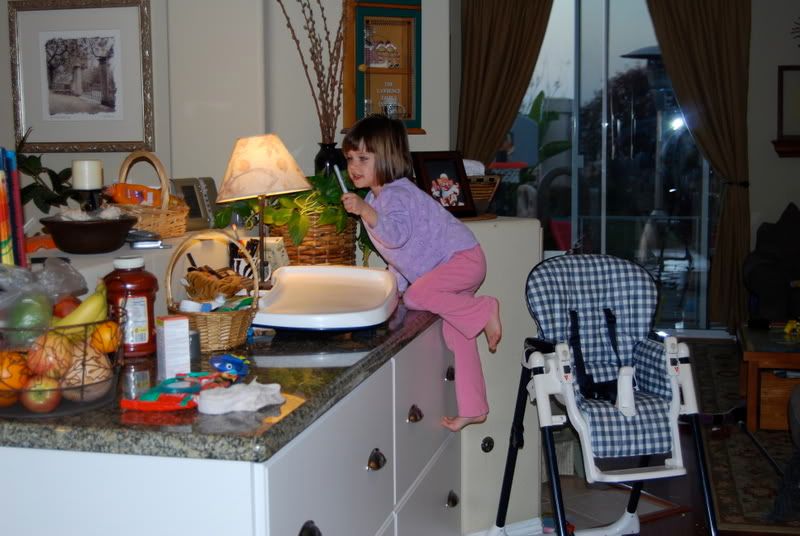
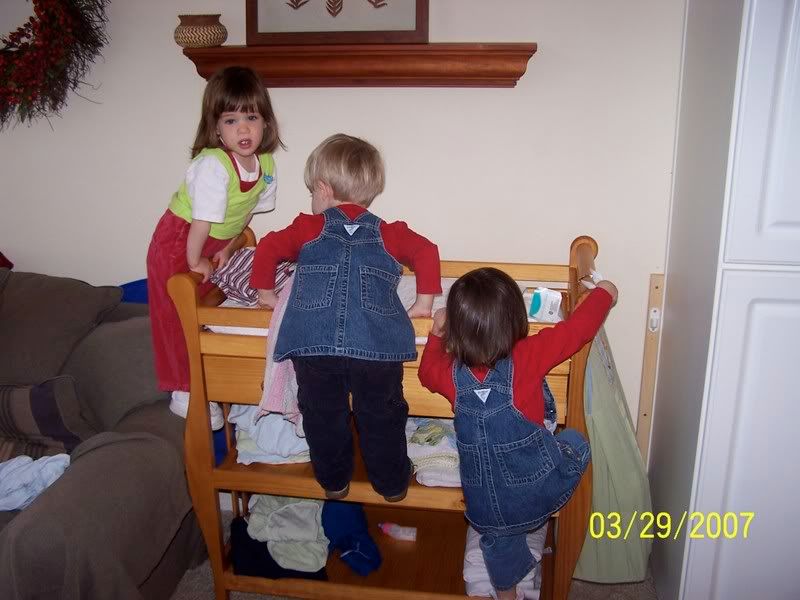
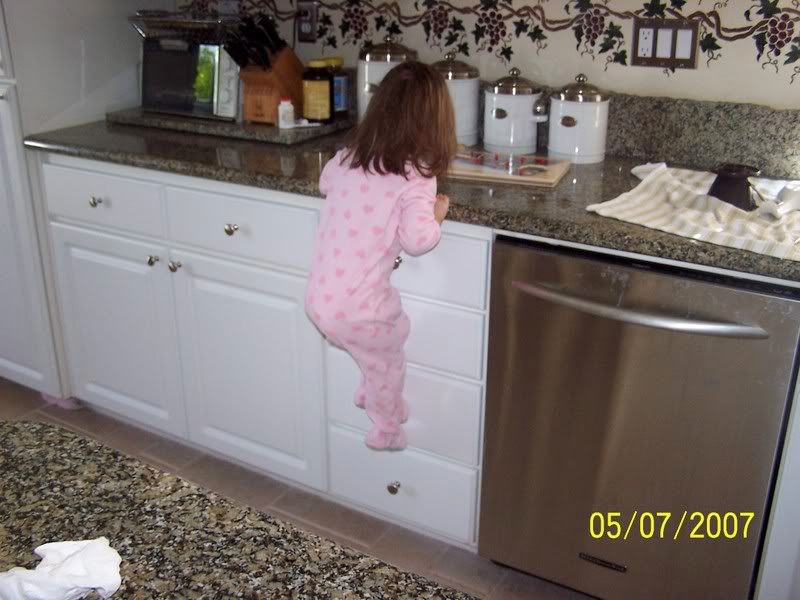
Our kids are forever climbing things. They climb counters, they climb drawers, they climb wall units, they climb bookshelves, they climb trees.

When we visited relatives that live in a 2-story home, they climbed the outside of the stairs.

The children have recently figured out how to dismantle "kid-proof" knobs and can now open most doors. Because they have been expertly scaling baby gates for the past several months, there are very few things that can hold back these kids when they have their mind set to something. On more than one occasion, I've rattled windows with yelling when I've found a rogue child perched on top of their dresser trying to reach a book.

Or, their piggy bank.

Or, the CD player.

Or, to just sit and take a look around.

We're teaching the children that they can get hurt if they climb on things that are not intended to be climbed.

But because they are three years old, they don't yet fully grasp the concept of "consequences", even though they have taken their fair share of bad spills.

Charlie and I feel like our home is very well baby-proofed are we are vigilant about watching the kids when they are awake. We're always on alert to where they are and what they are doing.

But still, accidents can happen.

Yesterday afternoon, I was perusing various news articles, when I came upon this one.

It is the story of a little 2.5-year old boy named Charlie, who is a triplet. Earlier this month, Charlie woke up from his nap and climbed on top of his dresser to retrieve his glasses - when the whole thing tipped over on top of him, crushing him to death.

My heart dropped to my shoes when I read the story.

Parents think about plastic covers for electric outlets. They think about putting chemicals up high and buckling their children in to carseats. But how many people think about bolting their furniture to the wall? And if they think about it ... how many people actually do it?

I will be the first to admit that yesterday at this time, not all of the top-heavy furniture in our home was safely bolted in to studs. In fact, only one piece was "locked down."


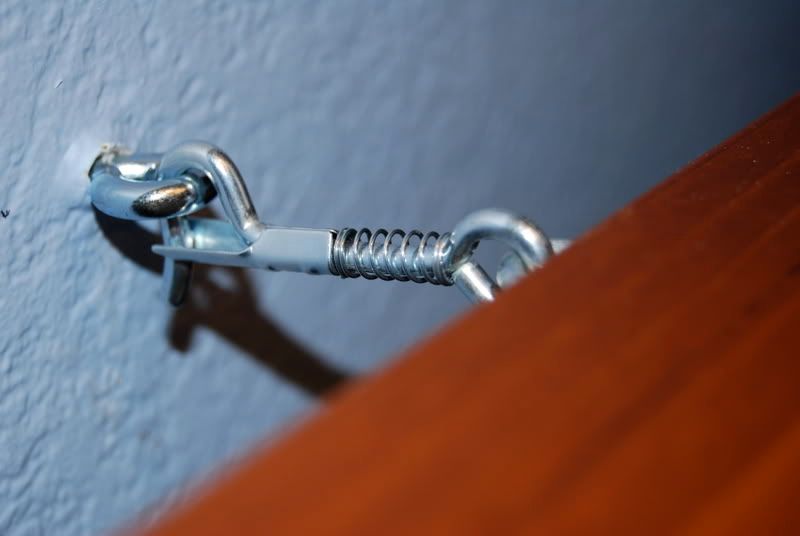
But 24-hours later, my husband has installed safety hook & eye locks in to every bookshelf, dresser and free-standing cabinet in our home. Instead of using the small screw that comes with the kit, we purchased 41mm screws that can penetrate drywall and embed more securely in to studs.

Incredibly, it took for me to read the story of another family's heart breaking tragedy, before I finished something I should have done as soon as our children were able to walk.